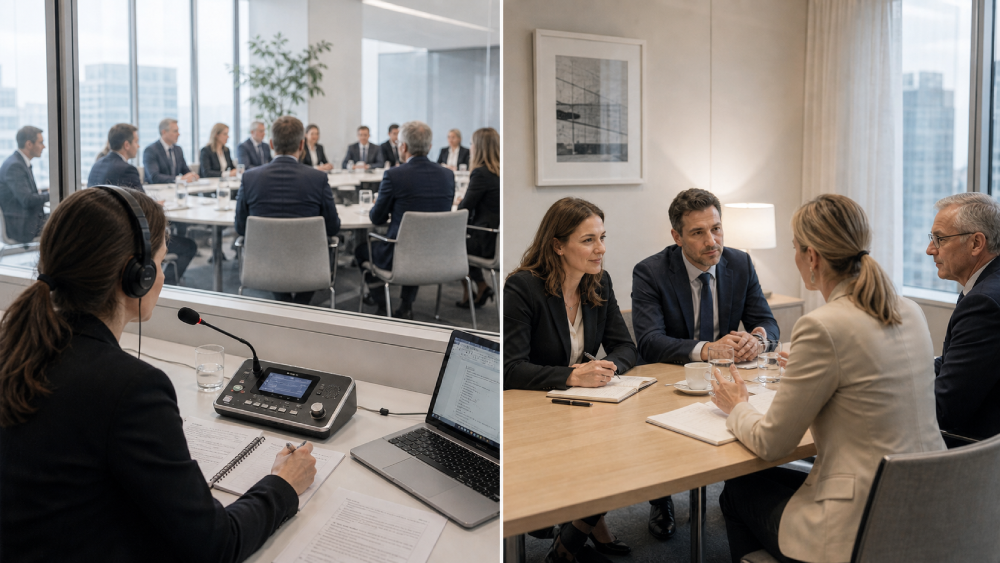
Titelbild für einen Blogbeitrag über Konsekutivdolmetschen und Simultandolmetschen

Simultaneous or Consecutive Interpreting? How to Choose — and Why It Matters More Than You Think

Simultaneous or Consecutive Interpreting? How to Choose — and Why It Matters More Than You Think
1 May 2026

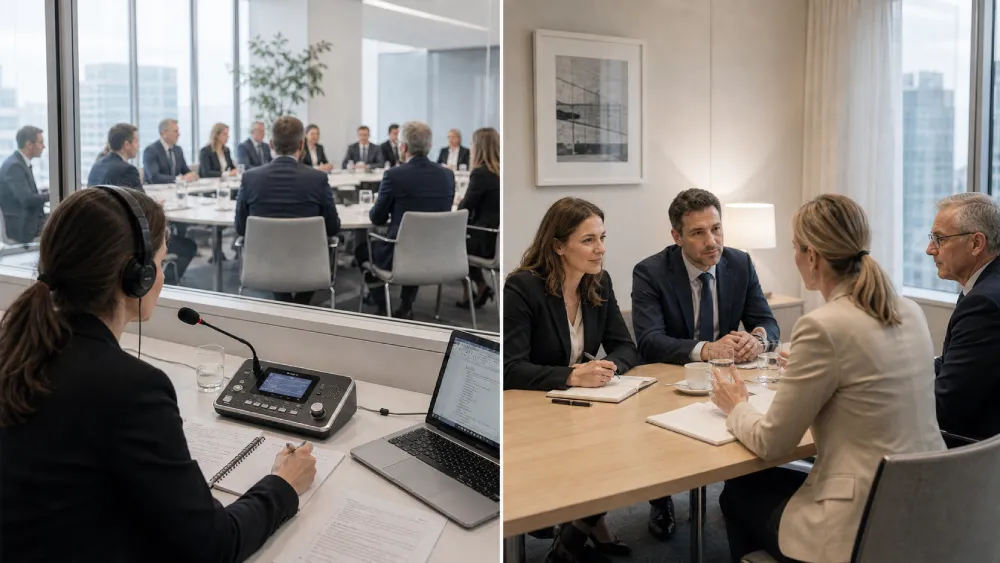
Interpreter working in a booth — simultaneous and consecutive interpreting compared

Book the wrong type of interpreting and you often end up paying for the meeting twice. Once for the day itself, once for the do-over, because the first attempt quietly fell apart and nobody quite knew why until it was too late.

It happens and I’ve seen it. The frustrating part is that the decision between simultaneous and consecutive interpreting isn’t complicated — it just needs to be made deliberately, and early enough to actually act on it.

Simultaneous Interpreting: The Meeting Keeps Moving

In simultaneous interpreting, the interpretation runs alongside the speaker in real time. While someone is talking, I’m listening and rendering in the target language a few seconds behind, but close enough that for the people in the room, everything feels continuous. The speech flows, the interpretation flows, and the meeting doesn’t stop to accommodate either of them.

This is the right choice for conferences, Works Council sessions, panel discussions, multilingual workshops — any setting where the conversation needs to breathe and pausing every few minutes to interpret would kill the energy in the room. Participants listen through headphones on a dedicated language channel. The speaker never has to slow down or wait.

The technical requirements are: a booth, microphones, receiver units, the right platform if it’s remote, headphones. You’ll also need two interpreters per language working in rotation — simultaneous interpreting is cognitively demanding in a way that makes working in long solo stretches genuinely inadvisable, not just uncomfortable. For smaller events, site visits or settings where bringing in a full booth isn’t practical, I use my own portable system.

Consecutive Interpreting: Slower, but Sometimes Exactly Right

In consecutive interpreting, the speaker talks first, then I do. I listen, I take notes, and when they pause or finish, I reproduce what they’ve said in the target language, fully and faithfully. Then the speaker continues, I follow, and so on.

For a genuine two-way conversation between two people — a negotiation, a bilateral meeting, a medical consultation — consecutive interpreting can be exactly the right call. The pace slows down, yes, but sometimes that’s an asset. Both sides have a moment to think. The exchange feels considered rather than rushed.

It also works for speeches before a small audience, where someone speaks for five or eight minutes and I then render the whole thing in one go. When it’s done well, it has a certain deliberate quality that simultaneous doesn’t.

That said, there are two things to keep firmly in mind.

First: consecutive interpreting always doubles the time. Whatever you’ve budgeted for the meeting — double it. A one-hour meeting becomes a two-hour meeting, reliably, every time. Plan for it or be surprised by it, but it will happen.

Second: a room full of people waiting to understand something they haven’t understood yet has a limited attention span. After ten minutes of listening to a language that means nothing to them, the most engaged, well-intentioned audience in the world starts to drift. You can’t switch concentration back on like a tap. If your audience is large and multilingual, consecutive interpreting will eventually work against you regardless of how well it’s executed.

The One Combination That Doesn’t Work

There is a configuration I want to flag clearly, because I’ve watched it derail meetings that were otherwise well organised: consecutive interpreting with more than two languages in the room.

Imagine five participants who speak five different languages, each with their own interpreter. One person makes a contribution. Their interpreter renders it into English as a bridge language. The other interpreters then pick up from English and interpret into their respective languages, one by one, in sequence. By the time the last delegate understands what was said, a significant amount of time has passed — and now someone wants to respond, and the whole sequence starts again.

I have been in rooms where this format consumed the meeting entirely. No conclusions were reached and the meeting had to be rescheduled. The interpreters were still paid, because they had done their jobs. The only thing lost was the meeting itself.

This setup gets offered — sometimes by agencies, sometimes for remote formats where it looks clean on paper. The appeal is understandable: no booth, no specialist platform, lower upfront cost. What it doesn’t account for is what actually happens to a multilingual conversation when every contribution has to queue for its turn.

The rule is simple: as soon as more than two languages need to communicate in real time, you need simultaneous interpreting. There’s no elegant workaround.

Remote Interpreting: What Works and What Doesn’t

Online meetings have introduced a persistent myth: that remote interpreting doesn’t require any special setup.

For a bilateral conversation handled consecutively — two languages, Zoom, decent microphones — that’s more or less true. The technology you already have is adequate.

For simultaneous interpreting remotely, it isn’t. You need a platform that supports separate language channels — Zoom with the language interpretation feature enabled, or dedicated interpreting platforms like Kudo or Interprefy. Without that infrastructure, there is no way for participants to select their language, and the interpretation bleeds into the original audio. What you get isn’t a multilingual meeting. It’s an expensive mess.

The good news is that sorting this out is usually straightforward, as long as it’s sorted out before the meeting rather than during it. If you let me know in advance which platform you’re using and how many languages are involved, I can tell you exactly what you need and whether any of it is more complicated than it sounds. In most cases, it isn’t.

The meeting just needs a plan.

Latest Articles

Volina Serban Logo

Interpreting

Training & Consulting

Contact

© Volina Șerban. All rights reserved.

Continue reading

Dolmetschen bei einer Sitzung des Europäischen Betriebsrats

What Nobody Tells You About Interpreting at European Works Council Meetings

What Nobody Tells You About Interpreting at European Works Council Meetings

20 April 2026

Interpreting at European Works Council Meetings

Picture the room. Someone flew in from Bucharest this morning. Someone else took the overnight train from Warsaw. There’s a delegate from Lyon who’s been in three meetings already this week, and someone from Munich who’s been on the EWC for eleven years and has opinions about all of it.

They work for the same company. That’s roughly where the common ground ends.

Different countries mean different labour law, different workplace cultures, different things keeping people up at night. A European Works Council meeting is where all of that lands in a single room, usually with a packed agenda, simultaneous translation running in multiple directions, and an expectation that something resembling consensus will emerge by the end of the day.

Getting the interpreting right at an event like this is the difference between a meeting that works and one that merely happens.

The Quiet Ones Aren’t Quiet

There’s something I’ve noticed repeatedly at EWC meetings, and it’s worth saying plainly: the delegates who don’t speak up are not always the ones with nothing to say.

Romanian representatives, in my experience, are sometimes written off as passive: they listen, they nod, but they don’t say much. The charitable reading is that they’re reserved. The less charitable one is that they’re not particularly engaged. In most cases, neither is true.

What’s actually happening is simpler, and more avoidable: they weren’t offered interpreting. At some point during the planning, someone made a judgement call — Romanians speak English, so we’ll leave them to it.

And yes, many do. But there’s a world of difference between reading a document in English at your own pace and following a fast-moving, emotionally charged debate in a language that isn’t yours. When you’re not entirely sure you’ve caught every nuance, and you’re definitely not sure you’d phrase your response correctly, speaking up in front of twenty colleagues from across Europe starts to feel like a gamble. So you don’t. You sit there, you follow as best you can, and the thing you actually wanted to say — the thing you know from your own site, from your own experience — stays unsaid.

A set of headphones on the table changes all of that.

Heat Changes Everything

Simultaneous interpreting has a built-in time lag. It’s small — a matter of seconds — but it’s unavoidable. The interpreter listens, processes and renders, and all of that happens just behind the speaker, not alongside them. In a calm, well-structured presentation, nobody notices.

In an argument, it’s a different story entirely.

When delegates are fired up, when people are talking over each other and the discussion keeps doubling back on itself, those few seconds of lag start to compound. The person listening through headphones is always slightly behind the room. By the time they’ve processed what was said and formed a response, the moment has passed and the conversation has moved on without them.

This is why how an EWC meeting is chaired matters as much as how it’s interpreted. One speaker at a time, proper pauses, space to finish a thought before the next one begins are what makes the interpreting work at all.

A False Economy That Costs More Than Money

Here’s a pattern I come across regularly: a company runs its EWC meeting in a different European city each year. Budapest one year, Lisbon the next, perhaps Kraków after that. It’s a good instinct, as it comes with visiting local sites, building relationships, and reminding everyone that the council represents real places and real people.

The mistake comes when the logic extends to the interpreting team. You’re in Budapest, so you hire Budapest interpreters. Next year you’re in Lisbon, local interpreters again. It looks efficient because it keeps travel costs down.

What it actually means is that your interpreting team walks into the room cold every single time.

Every company has its own internal language: the abbreviations, the names of initiatives that everyone in the room knows but that aren’t written down anywhere, creative names of innovative projects and bookkeeping software. Every EWC has its own history: the issues that have been running for three years, the friction between certain delegations, the topic that always generates forty-five minutes of debate regardless of how it’s framed on the agenda. An interpreter who is new to your organisation has none of that. They’re competent, certainly — but they’re spending cognitive energy on context that a returning interpreter already has. And cognitive energy spent on context is cognitive energy not spent on the actual interpreting.

The delegates notice. They might not be able to say exactly why the session felt rougher than usual, but they notice.

Preparation Is Not Paperwork

The agenda arrives punctually, almost always. The supporting materials — the presentations, the reports, the background briefings — arrive later, if they arrive at all.

An interpreter needs to know what’s actually going to be discussed: what the restructuring proposal says, what the figures in the annual report mean, what the technical term in the health and safety update refers to in each of the languages in the room. Without that, they’re interpreting words. With it, they’re interpreting meaning. The difference, in a meeting where the stakes are real, is considerable.

Sensitivity is often cited as the reason documents can’t be shared in advance. It’s a reasonable concern and an easy one to address: a confidentiality agreement, which interpreters sign as a matter of routine.

One more thing worth knowing about larger EWC sessions: when you have seven or eight languages in the room, direct interpretation between every pair isn’t always possible. What usually happens instead is relay — one interpreter renders into a bridge language, typically English or French, and colleagues working into other languages pick up from there. It’s an elegant solution when the team is tight-knit and accustomed to working together. When they’ve never met before, it’s a liability.

The Delegate from Bucharest Has Something to Say

Organising a European Works Council meeting is a significant undertaking, and interpreting tends to get treated as one of the last things to sort out — after the venue, the catering, the agenda, the travel arrangements.

It should be one of the first.

Bring the interpreting team in early. Keep the same team year on year wherever possible. Share the materials in advance, under whatever confidentiality arrangements you need. These aren’t niceties. They’re what determines whether the delegate from Bucharest — the one who took the overnight train and has been sitting quietly all morning — actually gets to be part of the conversation, or just present for it.

There’s a meaningful difference between the two. It’s worth getting it right.

Latest Articles

Volina Serban Logo

Interpreting

Training & Consulting

Contact

© Volina Șerban. All rights reserved.
Continue reading

Alles was Ihr Dolmetscher vor dem Einsatz wissen muss

What Your Interpreter Needs to Know Before the Day

What Your Interpreter Needs to Know Before the Day

14 April 2026

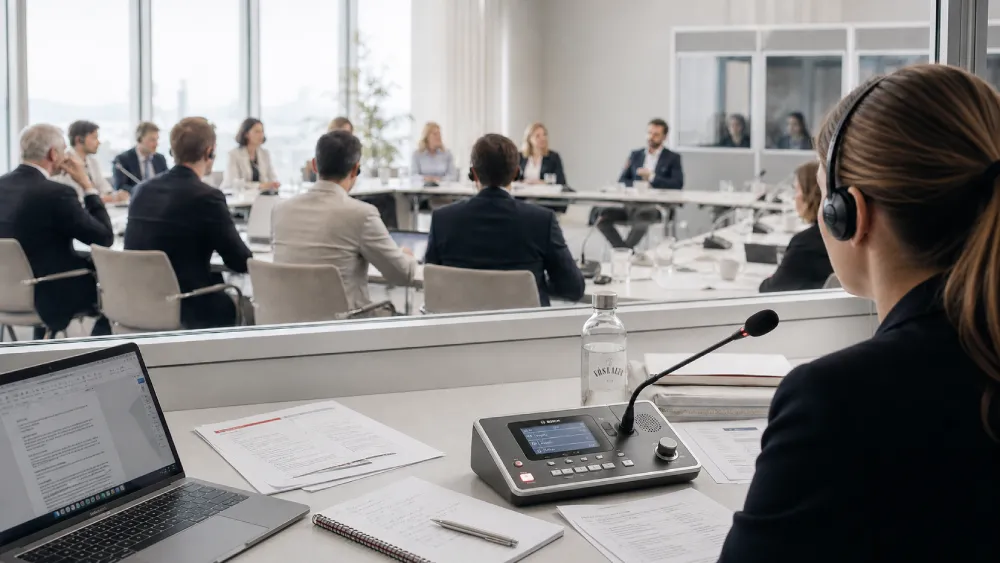
Conference interpreter preparing materials and notes ahead of a multilingual event

First-time clients almost always underestimate one thing: how much goes into the job of a conference interpreter before anyone sets foot in the room.

From the outside, simultaneous interpreting can look deceptively simple: someone sitting in a booth, listening and talking at the same time. What’s happening underneath stays invisible, and honestly, that’s the point. Good interpreting should feel effortless to the people relying on it. But for that effortlessness to happen on the day, a lot has to happen before it. And some of that, I genuinely need your help with.

Start with the Subject Matter — and Be Specific

When you first get in touch, please tell me what the assignment is actually about. Not “medicine” or “finance” — those words cover an enormous amount of ground. A continuing education seminar for GPs and a research symposium on oncology are both medical events. Linguistically, they have almost nothing in common. The same goes for a routine year-end debrief between long-standing business partners and a first-round negotiation with a company operating under a different legal system entirely.

Interpreters specialise, because specialist language takes time to absorb properly. I have areas I know well, and I will tell you honestly if something falls clearly outside them. That’s not a complication — it’s how a good working relationship is supposed to function, and it’s considerably better than discovering the mismatch mid-session.

What helps from the start: the specific topic, who’s in the room (specialists, a mixed audience, senior leadership?), who’s speaking, and whatever programme or agenda you already have.

Send Everything, Even the Rough Drafts

Preparation is where most of the real work happens.

Simultaneous interpreting places an extraordinary demand on working memory. While I’m listening to one thing, I’m already speaking another — processing meaning, finding the right register, keeping pace with a speaker who isn’t slowing down for anyone. What makes that possible, or at least less vertiginous, is familiarity: with the topic, the terminology, the way the argument is likely to be structured. The more of that I’ve absorbed beforehand, the less I’m improvising in the moment.

So please send me whatever you have. Presentations, even unfinished ones. Background papers. Relevant websites. Legislation that’s likely to come up. If your organisation has a multilingual glossary, that’s genuinely valuable. Consistent terminology across a full day of proceedings is a gift to your audience as much as to me. If you don’t have one yet, I’m happy to help build one.

I sometimes hear: “It won’t be that technical. You’ll be fine.” I don’t doubt it. Send me the materials anyway. What I don’t need, I’ll set aside. What I do need and don’t have is a much harder problem to solve.

Changes: The Sooner, the Better

Conferences shift: a speaker drops out, a topic gets added, the running order reshuffles at the last minute. This is normal, and I’m not precious about it. What matters is that I hear about it in time to do something with the information.

A change that reaches me the evening before is manageable. One that arrives ten minutes before I step into the booth is not. Quality suffers in those circumstances, and it has nothing to do with ability. It has everything to do with preparation time that no longer exists.

If something changes, let me know straight away. A brief message is enough.

A Few Things That Often Go Unsaid

On working in pairs. For assignments lasting more than half an hour, the professional standard is two interpreters working in rotation. Simultaneous interpreting is cognitively intensive in a way that has nothing to do with experience or effort. Concentration simply degrades over time, for everyone. If you’ve received a quote for a full conference day with a single interpreter, it’s worth asking a follow-up question.

On the technical setup. A booth that’s overheating, audio that’s cutting out, a monitor where I can’t see the slides aren’t comfort issues. They affect the quality of the interpretation directly. Having someone check the technical setup in advance, ideally someone who knows what they’re looking at, is time well spent.

On what interpreting actually is. I render what is said — faithfully, completely, without editorialising or softening. I don’t add my own assessment of whether something was well put, and I don’t quietly improve formulations I find clumsy. If you’d like me to play a more advisory role — in shaping language, in preparing speakers, in any capacity beyond interpreting — that’s absolutely a conversation worth having. Just have it beforehand, openly, so we’re both clear on what the brief is.

What Good Collaboration Actually Looks Like

The assignments I remember most fondly all had one thing in common: the client treated me as someone who needed to be informed, not someone who would sort it out regardless.

They sent materials without waiting to be asked. They passed on changes as soon as they knew about them. Sometimes, just before things got started, someone came over to tell me what the speaker was most invested in that day, what the room was likely to be sensitive about, what had been building in the background. It took only two minutes, but it made a real difference.

What happens in the booth is my responsibility. What happens before it is something we share.

Latest Articles

Volina Serban Logo

Interpreting

Training & Consulting

Contact

© Volina Șerban. All rights reserved.

Continue reading